Every now and then Whole Foods offers this lobster sandwich from their Street Food stand. It’s fabulous!

Every now and then Whole Foods offers this lobster sandwich from their Street Food stand. It’s fabulous!
To be held at Laguna Seca raceway Sept 25-27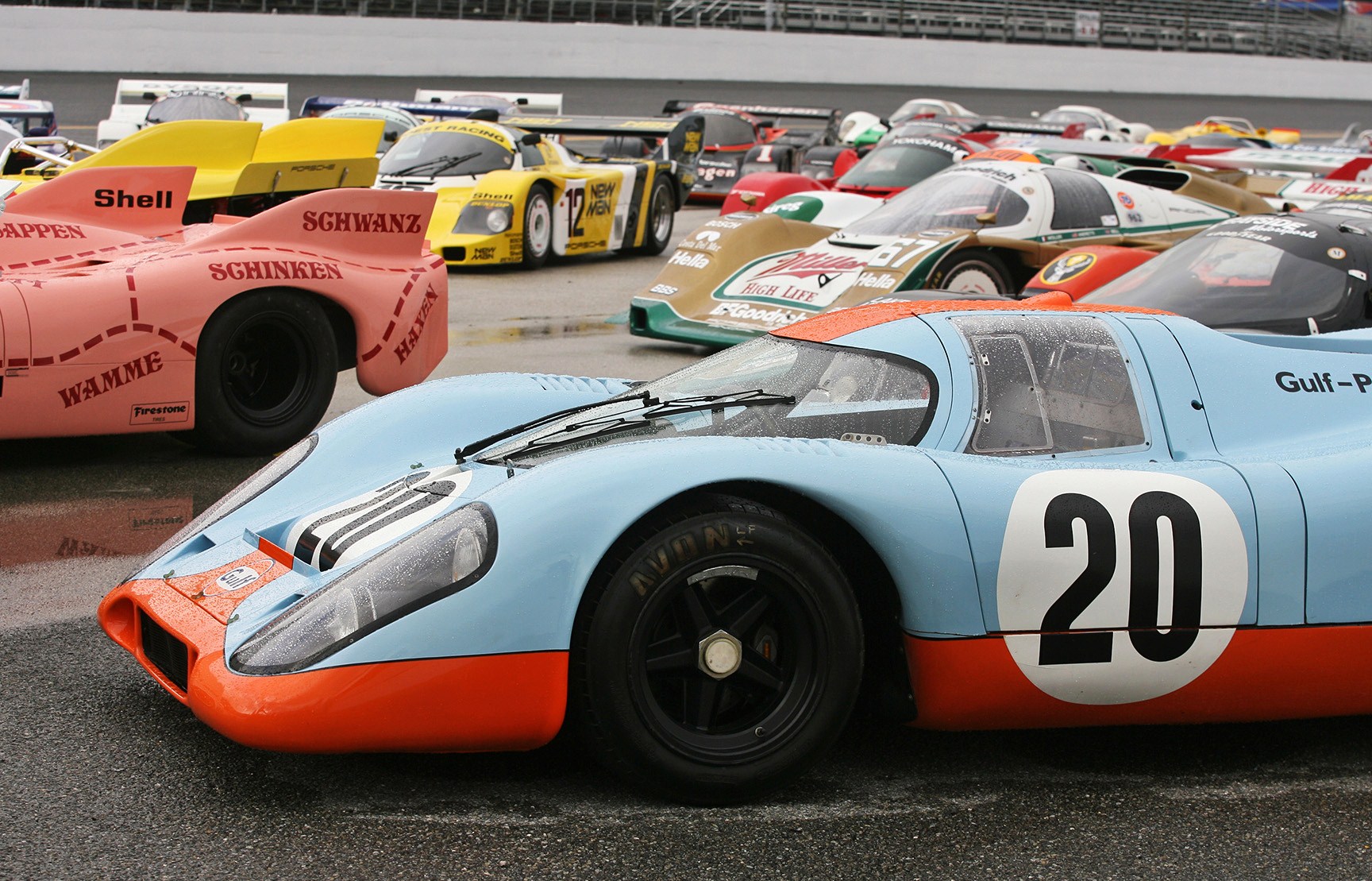
See the proposed route on this webpage.
My 2015 Cayman GTS arrived late December, and after waiting four months for it to be built and delivered, it was a real blast to drive a new car. I was sad to see the old Cayman go, but that’s the nature of cars–unless you can afford to keep all of them.
One of the reasons I bought the GTS was because I thought the Cayman GT4 (the more track oriented version of the car rumored throughout 2014) would not appear until the end of 2015 or early 2016. I was wrong, and Porsche announced the car in February and all production has been pre-ordered. It’s going to be a low production car coming out of the Motorsports division, the same place they make the GT3 ad GT3 RS.

Anyway, the GT4 is going to be a pretty amazing and special car. Check out this Chris Harris test drive of the car. As usual, he spends more time going sideways than going straight ahead, but that’s his style. The car sounds wonderful, and is equipped with lots of GT3 type goodies, a huge wing and beautiful carbon fiber bucket seats from the 918.
Maybe I’ll be lucky to get one in a couple of years, if anyone is willing to part with such a limited production car…
In a post-game interview, Seattle Seahawk coach Pete Carroll said (to paraphrase) that the second play was a throw-away, since they had the third down to let Marshawn Lynch (Mr. Beast Mode) make the big play, and the last play–if needed–to score the game-tying field goal. Talk a about a throw-away play…thrown right into the hands of Malcom Butler (Mr. Prediction!)
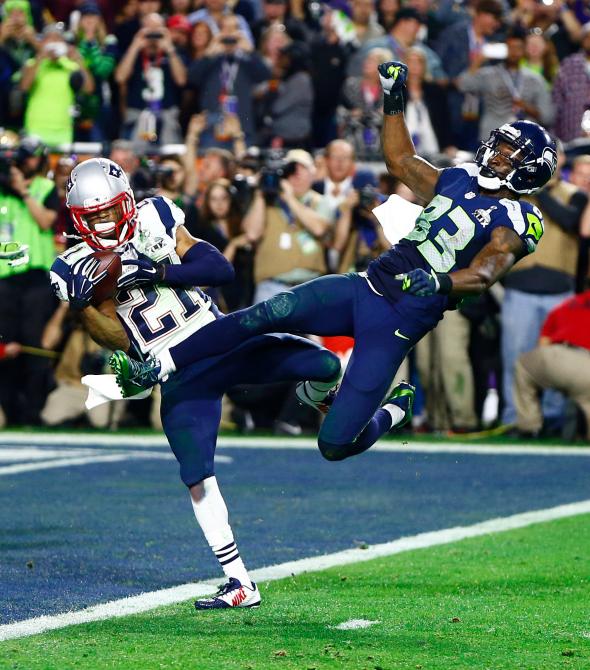
Photo by Mark Rebilas/USA Today/Reuters, from Slate online magazine
What coach Carroll displayed was, in my opinion, hubris plain and simple. A thrown ball is always riskier than a carried ball, yet he felt that the Seahawks, lining up with three wide receivers against a Patriot defense set against the run, could make the play and not only win the game, but win it in style. Hubris.
Some years ago while traveling in Italy, I saw a clock in a shop in Florence. I thought the design really fascinating. The clock was designed by Dutch artist Wil Van Den Bos.

A couple of years later I went searching for the clock and found it on Ebay, of course. Made in China, it uses cheap electric clock motors and is made of plastic painted silver, but it works and it’s cool. While there are many different models, the two (above and below) appeal to me the most. The one shown below (called imaginatively the “Big Gear Wall Clock”) is novel because the dial moves against a stationary hand.
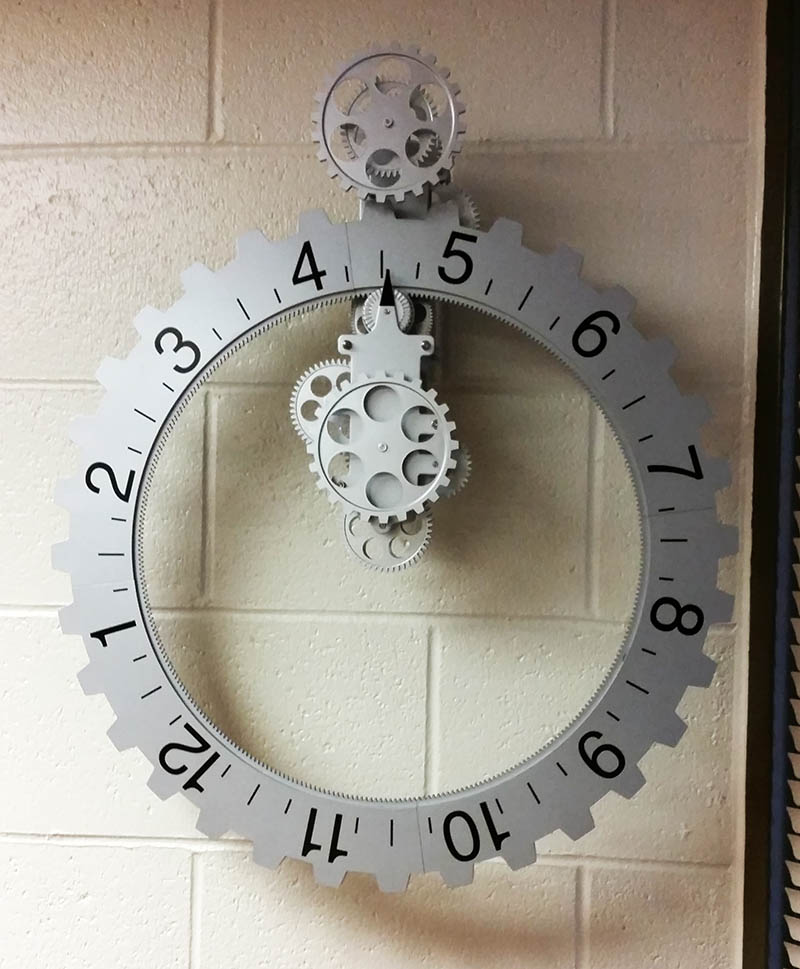
According to Wikipedia, this design–a fixed hand and moving dial–was common up until and including the 14th century. On a visit to the British Museum in London last year I saw the Cassiobury Tower (Turret) Clock, which is huge, and dates from around 1610. Its design is similar to the earliest tower clocks dating back to the 1300s. The first tower clocks didn’t have faces, but tolled on the hour, usually counting the hour with the same number of bell rings. Since many townsfolk were probably not within sight of the clock, it made sense just to indicate the time by a toll of the hour. As clock mechanisms got more accurate it was possible to add a minute, and even second, hand. I can’t find anything on the internet to tell me why clocks went to moving hands on a fixed dial, but I have a theory (just like Anne Elk.)
My theory is (and this is the theory that is mine), is that moving a dial takes a lot of energy. Dials are big and heavy. (The dial on the Cassiobury clock is about 12 inches in diameter–it clearly was not meant to be seen by townsfolk!) Hands are relatively lightweight, and consequently it’s far easier to move hands against a fixed dial than a dial against fixed hands. It also explains why the Big Gear Wall Clock is made of plastic rather than metal. It would be nearly impossible without much larger motors (and an energy source larger than two D cell batteries) to move a metal dial of about 20 inches in diameter around, even with gears and low friction. That’s my theory…
I have recently found that there are a few websites dedicated to making clocks out of wood, and some of those designs include a moving dial and fixed hand. Maybe I’ll find the time to make one…
I have often said, when hiring a new faculty member, that I prefer the best student from a small program to the worst student from the best program. But many universities hire the student from Harvard, or MIT, because of something called statistical discrimination. On average, any one graduate from a top program will have a higher probability of succeeding in an academic career than any one graduate from a lesser program. Hence choosing the Harvard PhD is a better “bet” than choosing one from Washington State University, for example.
The research published in the Journal of Economic Perspectives discussed in this article from The Economist supports my idea, albeit based on a very restrictive measure of productivity (the number of published quality-adjusted research papers). While the best students from the best programs clearly publish a lot of high quality research, the publication rate for the lowest 50% of graduates from all schools is the same. And the publication rate of the best students from lesser ranked programs is higher than the publication rate of the worst students from the higher ranked programs.
So there…

So you want to invest directly in real estate, and buy a house to rent? Good plan: have the tenant pay off your mortgage, and you end up with a real asset that’s worth quite a lot of money. But what kind of investment is it–in other words, what’s the effective annual rate of return, compared to an index fund, for example? Consider an example: Nice house bought for $150,000. To avoid PMI, you put down 20%* or $30,000, and pay closing costs–this is your initial investment. Your monthly mortgage, plus escrow payment is $1,100 and you rent through a property management company for $1,100 a month. Your actual income per month is lower than $1,100 because you pay a management fee, and there’s some maintenance, and maybe you pay the water bill. You pay tax on the income, but you get a deduction for the mortgage interest paid. You’re out about $200 per month after all this.
Over a 15 year period, the house might be empty a few months which increases your costs, and lowers your income, property taxes rise over time, as do fees, but hopefully maintenance remains about the same. Let’s say it ends up costing you about $40,000 net over the 15 years. (Remember you have to rent for quite a bit more than your monthly payments to avoid any of this loss.) After 15 years you’ve “invested” $70,000 in the house. If housing values rise by 3% per year (note this is about the rate of inflation, so the real value of the house stays constant) then your house is worth about $235,000. The gain is $165,000 which represents about 8.4% return per year. This is quite comparable to the long run annualized rate of return of the S&P500 Index at around 9%.
Investing in this house is about as good as investing in the stock market. But there are a lot of variables, including the initial equity, rental rates, maintenance costs, vacancy rate, the housing market in the future, when you want to sell the house, and of course, what the stock market is doing at that time. Many people have made money investing in real estate, but many have also done poorly, and could have done better by investing in the stock market.
* If you put less down on deposit–to leverage your investment more–you end up paying PMI, and borrow more, so your monthly payment is larger. Your monthly loss will be higher, so your total cost over 15 years might not be so much less than in the example above. It’s not obvious that less initial equity leads to a higher return on investment.
Americans have some odd, but not unexpected, views of income distribution in the U.S. In a recent survey reported in Slate, they thought CEOs earned about 30 times what the average unskilled worker earns, and thought the optimal ratio should be only seven times. However the reality is that CEOs earn about 350 times what that unskilled worker earns. That’s $12million compared to $35,000!
But don’t get too depressed, there’s a path toward the top, (well, not the Mt Everest top, but something in the Rockies, for sure,) and that’s — drum roll, please — with an Economics Degree! Another Slate article reports on research that finds those with economics degrees out-earn even engineers (!) especially if you earn in the top half of your income distribution. (Top earning economists earn a lot more than top earning engineers, while low earning economists earn just a little less than low earning engineers.)
So get out there and earn an economics degree–and make bank!

The new Mac Pro has a very nice cooling system that allows heat to flow out the top of the cylinder. How much heat in normal operation? Enough to power a (very efficient) Stirling engine.
I watched a really cool video from VW (the motorcar company) that brings home the idea that texting and driving, or more generally distracted driving, is a BAD idea, with serious consequences. Check out the video here. Not only is a great Public Service Announcement, even though it’s an advertisement, it also highlights one common myth about human beings brains. It is commonly believed that humans can multitask, but research shows this to be a myth. Actually humans are really good at switching between tasks very quickly. We can do one thing for a short time, then switch to another task very quickly, then to another, or back again. It –looks– like we are doing many things at once, but we are not. (For those of you who point out we breathe and do other things at the same time, realize that breathing is an involuntary action–we don’t normally decide to breathe, we do it automatically.)
The problem with distractions while driving is they draw our attention away from the primary task – driving – toward other tasks like talking to the kids, reading a text, checking out the wreck and associated traffic slowdown in the other lane… So we have to switch between driving, and the distracting tasks. Unfortunately many or most people underestimate the cognitive requirements of driving in traffic, so even though we can switch back and forth quickly, we end up doing a poor job of both tasks. And doing a poor job of driving is really not an option…
 Philip Ganderton