I have new logos for my two personas. I use them for my social networks and forum posts.
Philip Ganderton

Dr Phil Gandini

I have new logos for my two personas. I use them for my social networks and forum posts.
Philip Ganderton
Dr Phil Gandini
My darling Maria sent me this link about use and utilize. It reminds me of the times my English (now Language Arts) teacher admonished me for using big words when a smaller, and more common, word was not only good enough, but sounded better and far less pretentious.
Maria and I share a love of well written prose as evidence the author cares about both the idea expressed and the reader. Writing well is a sign of respect for your reader. And making use of the right word is fundamental to good writing!
Really? Do we need yet another popular (best selling) book written by a true-believer economics professor helping us all understand the world we live in? Yes, of course, that’s what economics, like every other academic discipline, is intended to do: to help us understand, and consequently control, our world, including ourselves. But I just don’t get why there are so many books written by economists deconstructing everyday issues and events using economics so we can all realize we are either irrational, or worse, just plain stupid.
For me it started with the Armchair Economist: Economics and Everyday Life, by Steven Landsburg published in 1995. Then came Freakonomics: A Rogue Economist Explores the Hidden Side of Everything, by Steven Levitt and Stephen Dubner, published in 2009, which became such an instant hit that I had to read it just to answer questions from people who were reading it and wanted to check in with me, an ECONOMIST, either to confirm their understanding, or test mine. Now it’s Tyler Cowen’s new book An Economist Gets Lunch: New Rules for Everyday Foodies. There’s an interview with the author on NPR’s Morning Edition.
Don’t get me wrong, I think financial literacy is woefully lacking in the US, and we should be doing much more to improve it (despite what Suzie Orman is doing,) and I personally spent just short of 20 years appearing occasionally on the local rock station (94Rock) with DJ TJ Trout trying to help a few listeners better understand the economics of what current news story was upsetting TJ that week. I was officially called the 94 Rock Economist, so I did achieve celebrity status, but I am much poorer than Landsburg or Levitt or Cowen… Economists can, and should, devote a significant fraction of their time educating others, and researching a better understanding of the complex financial and economic world in which we live.
But a lot of what these popular economics books deal with is at least trivial, and often pointless. Cowen advises staying clear of restaurants with lots of beautiful women, because patrons are there to pick up women, not eat, and the owner knows this, so isn’t investing much in the cuisine. You can expect a pretty ordinary culinary experience for which you’ll pay a stiff beautiful-woman premium! First, did we really need to be told that? And is Cowen really smart to have told us what we probably figured out ourselves? My guess is there’s a whole lot more going on at these bar/restaurants, and with their patrons, than Cowen’s simplistic analysis suggests or explains.
I went to graduate school with a guy who wanted to explain human sexual mating behavior using economic principles. It wasn’t a new idea then, and it certainly isn’t a good idea, other than to realize economic theory has modeled some pretty fundamental behavioral responses to incentives that are widely applicable, and have helped researchers in many disciplines better understand and explain the behavior they have studied for a very long time. But this doesn’t mean economists have all the answers. I hope not, anyway.

I was listening to this article on NPR this morning and a statement was made about advanced journalism students failing to recognize the importance of “on the ground” journalists like Woodward and Bernstein in the uncovering and breaking of big news stories. The idea presented by Tina Brown in the NPR spot had students believing they could look up news on the Internet rather than interview people and do the hard work of investigative journalism. It got me thinking about my, and in general, our, use of the Internet, and what we find when we Google a word or phrase.
I’m a big fan of Wikipedia, and I use both traditional (Wall Street Journal, The Economist, NPR) and new (Slate, The Beast — although that’s just Newsweek in another guise) sources to learn about what’s happening in the world. I use an iPad to access this information (I characterize the iPad as the greatest media delivery system invented so far) and enjoy both breaking news and “magazine” style articles including movie and book reviews. I read with an open mind, but I’m also skeptical that not everything posted on the web is the TRUTH.
The question is: where does all this Internet material come from? Is it all just recycled from other internet sources–if so, then where’s the chicken and where’s the egg? Obviously there must be some external source of information from which the Internet, repackager and recycler though it is, gets the basic information. An interesting consequence of this would determine what percentage of material on the internet is original, and how much is regurgitated. I’d guess the latter outweighs the former by a large margin.
Most days I think of something to post to this blog, but by the time I get to work (where I do my best work,) it has slipped my mind. Lots of things slip my mind these days.
Some of the ideas for posts sound great when I’m thinking them, but then after a little more thought I realize that reading them wouldn’t be so great! Oh well.
Although the blogosphere is a large place and it takes all types, there are a few archetypes: the personal blog, the photoblog, the social/political commentary blog, the celebrity blog, or the product blog. Most people who start a blog go the personal blog route, and find themselves at a dead end pretty quickly. Ultimately the only personal blogs that people read are those written by and about people who live really interesting lives. Ordinary just doesn’t sell…
Everyone wants to write the Great American Novel, and a lot of time and energy must be expended before those handful of people who can actually write well emerge from the crowd. Just as everyone can run, but few win marathons, only a few people are writing really interesting blogs. The access and democracy of the internet makes for lots of wannabes, (WordPress says that nearly 1 million posts were made to WP blogs today alone–over 190 million words!) I can imagine how many of those posts and words were read by other people, and most were read by the author alone. Like this post…
I’ve never been to the Bordeaux region of France. I’ve never been to France. (I have been to the UK and Italy.) But I drink wine from Bordeaux. Quite a bit of it, actually. The bottles I drink sell for between $15 to $25, which means I’m not drinking the best French wine by any measure (I would like to drink a Margeaux or a Haut-Brion before I die.)
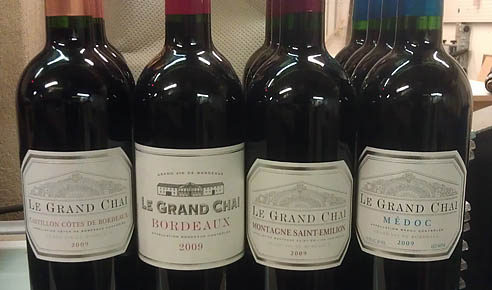
I recently ordered a few cases of mixed Bordeaux from the 2009 vintage, which is being mentioned amongst the great vintages of that region. I haven’t drunk enough wine to make a good comparison, but generally they taste great, like French wine. I’m not educated or skilled enough to describe smells and tastes (other than “barnyard” which is a rather obvious smell and taste sometimes found in French wines that I’ve tasted,) but I can identify a complex pattern of chemosensations that appears unique to French wines, and particularly Bordeaux. …and I like it!
On this day that the death of Ferdinand Porsche the designer of the Porsche 911 was announced, it seems appropriate to reflect on why I drive a Porsche. I recently posted to a thread on the Porsche Cayman/Boxster forum Planet 9 the following thought:
Very few people drive their very fast cars on the track, and even then they rarely come near the limits of the car. Who cares if a car gets to 60mph sooner than my Cayman? Who cares if it can do 180 when mine will only do 171 (this is the published top speed)? I spend 99% of my time averaging 27mph (that’s what my computer tells me). For me, averaging 27mph in a Porsche is a better option than doing it in any other car. Period.
The thread was about Porsche falling behind the competition, especially with the notoriously under-powered Cayman. Regardless of the context, for me the last sentence holds the answer to the question why I drive a Porsche. I drive my car every day to work, at 8am and 5pm, in congested, stop-go traffic surrounded by idiots and distracted people who should not be in charge of a machine that can cause more damage and trauma than I care to imagine. That’s why I average 27mph. But if I have to be there, doing that, then I’d rather be in a Porsche Cayman than any car I can list as “competition.”
Maria, my wife, has taught me to reduce my use of the word “that.” And it works! That may be one of the most unnecessary words in English. Write a paragraph, notice how many times you include that, then eliminate (nearly) all the occurrences, and you’ll see you can live without that. I bet your paragraph sounds better, too. There are some valid uses for the word, most notably if you wish to be specific about an item: “Can you hand me that glass, please?” as you point to the champagne glass among the beer glasses. Even then, you may be able to use a more specific descriptor to avoid using that. It’s a crappy word.
I recently bought a new iPad app called Paper. It’s a graphic arts creation program that allows you to create graphic images in ink, pencil, Sharpie, and brush. The program is simple, and has quite limited features, but the beauty of the tools seems to outweigh these limitations. You can try it out with the fountain pen tool for free. It looks beautiful on the New iPad’s Retina display. Click the avatar below to learn more.

I just read an article by the wineeconomist.com describing the retail model used by CostCo to sell wines. CostCo is the largest wine retailer in the US, yet stocks far fewer  wines (usually 100-150) than liquor stores.
I personally like CostCo as a source for wine, despite the limited choices, as their quality and price seems to be fit my tastes especially well. My most recent purchase was a wonderful 2009 Bordeaux from the Medoc area (accompanying photo.) This is a wine Robert Parker, Jr likes, but honestly, what Bordeaux doesn’t he like? It just depends on whether he gives it 92 or 98 points. While this wine would fall on the lower end of that Parker scale no doubt, it’s also less than $20 at CostCo and has a wonderful Bordeaux taste.
I drink French and Italian wines almost exclusively. Not because I’m a snob, but because I just like the flavors of those wines. I really enjoy California cabernets, and Oregon pinots, and wine from the central California coast, but most are too pricey. I generally pay $10 to $20 for wine, and rarely pay more–but when I do, it’s for California wines. Although I am Australian, I don’t drink Australian wines, and I haven’t found a South American wine I like.
I still think the movie Sideways was one of the best movies I’ve seen. The dinner scene in the Hitching Post (II) restaurant is exquisite–up to the point when Miles goes all batshit crazy and calls his ex-wife, that is. The best line (outside the restaurant before that meal): “…if anyone orders Merlot, I’m leaving. I am NOT drinking any fucking Merlot!” Words to live by.
 Philip Ganderton