I don’t mean “in person,” I mean to watch. In this case, on television. I have always argued the televised coverage of golf–with its switching between holes and players, tees and greens, great hits and great misses, is unsurpassed in its ability to compress space and time for the more complete enjoyment of the viewer–is about as good a spectator experience as is imaginable. And far better than being there in person. This article captures my sentiment very well.
Category Archives: Ramblings
Better off alive than dead?
Probably not, especially as we have (arguably) no evidence of what it’s like to be dead, especially over the long term. And the only people asking this question appear to be alive, so I’d conclude we are all better off alive. However, earlier this year when the official count of heads on the planet reached 7 billion, the question was asked:compared to the 7 billion alive, how many people are dead? Many articles gave an answer, and the modal answer (available in this article) was 107 billion came before us. That means there’s a ratio of about 15:1 of dead to living people at present. And that’s apparently a pretty good estimate.
BS
Aside
Like Saturday Night Live’s Emily Litella, I want to protect endangered feces!
Crazy economics: baggage fees on airlines
The following weirdness just happened while traveling with my daughters to meet their mother in New York a few weekends ago. Unwilling to carry on our bags, we paid $75 to check three bags with American Airlines. Having passed through the TSA checkpoint, while waiting in the boarding area, the agent announced that anyone willing to check their carry on baggage at the door of the jetway could do so–free of charge. Well, the agent didn’t actually say free of charge, but no one taking advantage of this option (to reduce overcrowding of the overhead bins on a full flight) was charged to check their luggage. The flight was full, as usual, and people were trying to stuff large refrigerator-sized bags in the overhead bins–god forbid they would place them under the seat in front of them–while the flight attendant pleaded for all to be seated so that the door could be closed and the flight begin. (By the way, I hypothesize that the official record of when the flight took off is when the door is closed, and being sensitive to these widely published performance measures, airlines are quick to close the doors, even if the plane does not actually leave the ground until some unreasonable time later.)
Back to the checked luggage fee. I could never figure out why the airlines charged for checked bags which simply fill the empty spaces in the belly of the plane (read: marginal cost of carrying an extra checked bag, zero) but let people carry on steamer trunks for free! It seemed to me that the reverse would make more sense: let people check as many bags as they want for free, but charge them a stiff fee for stuffing those overhead bins (care must be taken when removing your items as they may have shifted in transit.) Passengers would all be seated much quicker, those sitting in the isle seats would be a little less bruised, and more departures would be on time. But further investigation has revealed a possible explanation for what I deemed folly.
I discovered that while airlines are charged a 7.5% excise tax on all flight related sales (tickets, change fees, etc.) they do not pay the tax on extra services such as checked baggage or early boarding. Also, about five years ago, in response to pressure from Congress, airlines agreed not to charge for carry on luggage. The incentives are clear: airlines want to avoid paying taxes (like the rest of us,) so they don’t just hike ticket prices. They increase revenue by charging for things people really can’t avoid when traveling (luggage.) They don’t care about the discomfort imposed by people carrying on tonnes of baggage while upholding the promise not to charge for carry-ons.
But there is a possible work around! Don’t check your bags at the counter, take them to the gate and accept the agent’s offer to check them there, for free!
Another vinegar tale
I read The Billionaire’s Vinegar a couple of years ago. It’s the story of old wine, Thomas Jefferson and possible fraud. I learned two things from reading it: a lot more about old French wines than I knew before, and too much about people who have so much money they can both collect and drink wine costing thousands of dollars a bottle.
A new wine fraud story has emerged, and is reported in the New York magazine. It’s still on-going and a small part of the world revealed in the Billionaire’s Vinegar, but makes for a good story well told.
Those smart economists
In a previous post I commented on Everyday Economics, and revealed my (mild) disdain for economists who think they can explain everything. Well, here’s another example from the New York Times.
But this time, I think they might have it right. And I particularly like on the comments that asked if there was an equation to predict why we care about celebrities. That’s been a question I’ve pondered for quite some time, and all I hope is that it would predict for me a “Celebrity Care Index” of zero!
One of my pet peeves

An expensive little habit
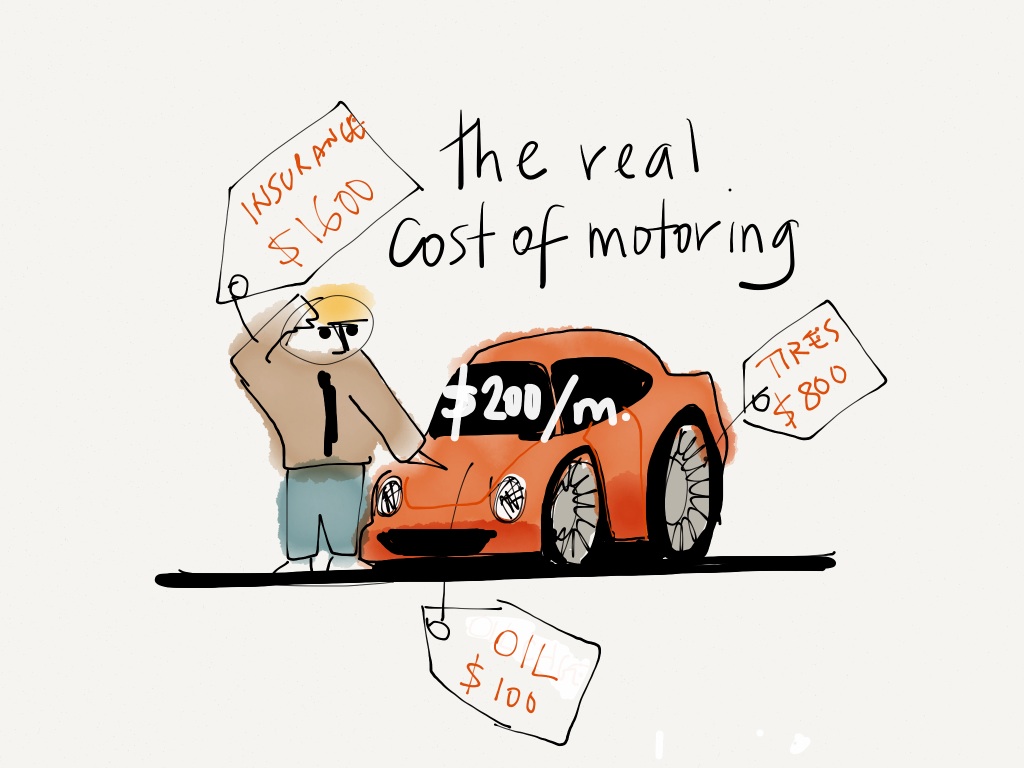
A new article reporting on a recent AAA study posted on Autoblog finds that the average cost of owning a car is almost $9,000 a year. The cost includes insurance, gas, maintenance and depreciation. It does not appear to include interest on auto loans and repair costs. Small cars are cheaper to own and big SUVs are the most expensive. I wonder how much it costs to own a Porsche?
Pinteresting…
I recently took a look at Pinterest, the latest social network phenomenon to go viral. It reached 10 million active users quicker than any other social network site. It’s been accused of being a virtual scrapbook for girls/women and appears to attract a certain age group that’s not young teenagers (they’re still totally immersed in Facebook,) and not much older than 40. As most people log in using their Facebook account, and can link their Pinterest posts automatically to a Facebook entry, it’s not really competing with Facebook other than for that most scarce of resources, user time.
But is Pinterest adding anything to the Internet? In an earlier post, I talked about the Internet and originality, and Pinterest seems to be the antithesis of originality. Just as people cut things out of magazines and paste them into their scrapbook, people see images on the web, and pin them to their Pinterest boards. There are very few original images on Pinterest–perhaps close to none. So what is the value added of Pinterest? According to Wikipedia, “Pinterest is a pinboard-style social photo sharing website that allows users to create and manage theme-based image collections such as events, interests, hobbies and more.” Create and manage has been used by some commentators to argue that we are all become, wittingly or not, curators (my apologies to curators around the world.)
In a world in which massive amounts of data/information are being generated and transformed at break-neck rates, there’s clearly a need to organize it, and make it available. Given the almost infinite number of ways to do this, social networks and image collections are becoming not only the new way of curating data, but the definition of curating data. Are regular folk like you and me good curators? I don’t claim to be one, but recognize that simply by posting to my web, I am implicitly making decisions about structure and organization that affect how visitors read, view and absorb the content I am delivering. Is it OK for everyone to be unintentional curators, and if not, can we stop it?
I doubt it.
The best investment you’ll ever make
I know, the best investment you’ll ever make is in yourself. Investing in human capital through education has been shown to produce the best long term rate of return, period.
I teach a Personal Investing course at UNM, and occasionally offer tips. And this is a big tip (better than Blue Bonnet in the 5th at Ascot, trust me.)
Pay off your credit card balances as soon as possible.
Some would say that creating the credit card balance in the first place is a bad idea, but credit cards aren’t bad, per se. They offer the ability to even out cash flow–you can buy things when you don’t have (or don’t want to carry) lots of cash, but expect to have enough in the future to pay back the loan from the credit card company. If you pay the loan back the same billing cycle, you don’t pay any interest, but if you take longer then the interest is generally pretty stiff (an Ann Taylor credit card charges 25% annual interest!)
If you do take out a credit card loan by carrying a balance on the account, then paying the balance off is an immediate release of the money you would have paid in interest. You can’t start saving and investing while you’re in debt, by definition. Well, you can’t expect to get ahead if the interest you pay on your debts is larger than the interest you earn on your savings or the implied rate of return on your investments, is a better way to put it.
So, use your credit card wisely, and don’t carry balances. This is step one in achieving financial independence and security.
 Philip Ganderton