 |
According to an article on Investopedia, women are more likely to carry a balance on their credit cards, pay late fees and pay only the minimum per month on the card balance, than males. With single women having home ownership rates twice that of single men (NPR,) they are clearly earning well and wanting financial security, so becoming financially literate is especially important. |
Teen Pregnancy
Some years ago I wrote two reports for the New Mexico Department of Health about the economic costs of teenage pregnancy in the state. (Here’s a link to the second report from 2006.)
A recent article in the Atlantic online magazine makes the excellent point that the biggest cause for teenage pregnancy and childbirth is the one least likely to be mitigated by the common responses to teen pregnancy. Rather than issue teenagers with condoms, or make them attend abstinence programs, the solution lies in the lack of alternatives many teenagers have, or think they have, to bearing a child. Data from New Mexico shows that about 56% of teenage women who gave birth intended to have the baby, another 34% wanted a baby but would have preferred to wait until they were older. Why would teenage girls choose to have babies, given what we know, and they can easily find out, about the negative outcomes that follow? Why is having a baby as a teenager a better alternative than continuing at high school, or going on to complete a college degree, or even getting a job and waiting to have a baby later in life?
New Mexico continues to hold the rank of having the second highest teenage birthrate in the country (2010 data.) The birthrate has fallen, (from 65 per 1000 in 2000 to 53 per 1000 in 2010,) but it continues to be highest in the poorer states. When young girls have mothers, and sometimes fathers, who are struggling in poverty, and see more of the same around them, and see little in their futures other than the same fate, having a baby now may not seem such bad decision. The opportunity cost is not high, and for many, having a baby opens up doors to assistance and support they were not receiving before.
Girls who live in poverty, and who engage in risky behaviors are more likely to get pregnant and give birth as teenagers. There are many reasons that have little to do with economics, but economics can provide some understanding, especially when it comes to finding solutions. Should we spend more money on abstinence programs, or more on programs that expose girls to alternatives, and a path to breaking the vicious circle they find themselves locked in?
After the Run
Image

Maria and Emily teamed up to do the Run for the Zoo 5k time run on Sunday, May 5, 2013. Way to go!
Singer Porsche
Take a look at this beautiful “reimagined” Porsche 911 by Singer.

Buy a pre-owned 911, give it to Singer along with $250,000 to $500,000 and this is what you get back. Rebuilt, redesigned, modern, safe, and yet true to its origins. I can only imagine it’s wonderful to drive and better to own.
There’s a short article about Singer in the Ralph Lauren magazine with some nice information.
Right to Work
Having just recently testified in an arbitration between a union and an employer (in the grocery store sector,) I was thinking about the “right to work” and the current trend for states to introduce right to work laws. According to Wikipedia (the oracle,) the right to work refers to laws in states that effectively prevent a union from collecting a fee from employees working in businesses in which the union has a collective bargaining agreement. Presumably, if a union is present, it is negotiating on behalf of all employees, and should be allowed to levy a fee from each in return for that representation. In Right to Work states, a worker should have the “right to work, free of coercion to join the union, or at least pay the union fees.” As noted in the Wikipedia entry, a right to work law does nothing to ensure workers have any rights to work…
Unlike the right to life, or the right to choose, or the right to be wrong, the right to work doesn’t seem to be self-explanatory. Here’s a great Slate article on the origins of right to work laws.
Wine BS
I know I keep posting about wine snobbery, but this is about as good as it gets:
“…the 2010 Chateauneuf du Pape Les Origines. A blend of 50% Grenache, 30% Syrah and 20% Mourvedre (45- to-95-year-old vines) aged in small oak, it exhibits an opaque purple color as well as a sweet bouquet of blackberries, espresso roast, ink and graphite. While clearly a modern-styled Chateauneuf du Pape, it retains plenty of the region’s typicity and authenticity. It should drink well for 15+ years” (from a Robert Parker review)
The sweet bouquet of ink and graphite? As this blog says so well, this is Wine Bullshit at its best! (I have previously blogged about wine experts, among other topics on wine, here.)
B is for Bokeh
Bokeh (pronounced bow-kuh): Japanese for really cool out of focus backgrounds in photos!

The background of a photo is out of focus because of the aperture chosen. A large aperture will cause most of the background to be out of focus. This is true for every lens, but some lenses give the out of focus background a special character–bokeh. No one talks about the bokeh of a 50f1.8 lens other than to say it’s crap. You will hear people talk about the bokeh of a 200f2, or one of the most famous Canon lenses, the 85f1.2LII, which was used to make the sample photo above.
Don’t expect to see much out-of-focus background when using a small sensor camera, such as a cell phone or a point-and-shoot. The physics/optics of these cameras mean that almost everything is in focus, much as in a pin-hole camera photo. (As an aside, there is much irony in the use of f64 with a large view camera of the kind used by Ansel Adams–although the format lends itself to producing massive bokeh, the members of the f64 club used incredibly small apertures in order to increase the depth of field when making landscape images.)
Bokeh is not something you have much control over, other than buying a lens with good bokeh. It’s also not something to get worried about. Most people who view your photos are not going to get all critical about the average bokeh your lens displays!
A is for Aperture
This is the first in a series of posts about photography. Let’s hope I can make it to Z!
 Aperture
Cameras capture images by allowing light to fall on the sensor (it used to be the film, but those days are over for the vast majority of photographers.) the amount of light falling on the sensor is the exposure. The exposure has two dimensions: the size of the light (aperture) and the time that it lasts (shutter speed.). Think of filing a bucket with water. The amount of water in the bucket depends on the size of the hose used to fill it, and how long the hose is turned on.
A given exposure can be achieved with a number of different combinations of aperture and shutter speed, for example 1/125 sec at f2.0 is equivalent to 1/250 sec at f1.4. A bigger “hole” for a shorter time.
Aperture is measured in f-numbers. The f-number indicates the ratio of the focal length of the lens and the diameter of the opening in the lens formed by the blades of the diaphragm. So a 50mm f2.0 lens has a maximum opening of 25mm diameter.
The photo above shows a Canon 85f1.2LII lens. The maximum aperture of this lens is 71mm (2 3/4inches!)
The maximum aperture of a lens indicates its speed. A lens with a large aperture (small f number) is a fast lens. You can use these in low light (indoors) to get photos that might otherwise need a slow shutter speed and cause blur.
The aperture of a lens is adjustable–you can “stop down” a lens to make the size of the hole smaller. Why? The aperture controls the depth of focus, or depth of field. This indicates the parts of the scene that are in focus. An image exposed with a large aperture will have a very shallow depth of field — only those things very close to the point of focus will be in focus. All other parts of the scene will be out of focus. Using a small aperture will make nearly everything appear in focus. It’s common to use a large aperture to make a portrait of a person (head shot) and have the background out of focus (see bokeh.) Landscapes are usually made with a small aperture, so that both the flower in the foreground and the mountains in the background are in focus.
As one of the two main controls of exposure, aperture is well worth understanding. Sometimes you can’t do much but open up the lens to maximum aperture (low light photos), but when there’s a choice, use the aperture as a creative control.
Notes on tipping
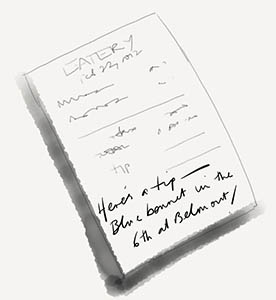
I read this article on tipping from an ex-waitress. (I thought it was politically correct to refer to them as servers nowdays, but I guess it’s OK for an ex-waitress to call herself whatever she wants to.)
I have a simple rule on calculating the tip that I’ll share. Take the first digit (the 2 of $24.50) and double it, to get a $4 tip. This is 20% for a $20 bill, but only 15% for a $29.99 bill. So you can either still closely to it, and hope the over- and under- tips average out with repeated visits, or you can do some rounding ($29.99 is really $30, so tip $6.)
I agree with the ex-waitress that 20% has become the norm for tipping and it’s easier to calculate than the old 15% tip.
But the point she makes that I agree with most is that if you cannot afford to tip 20% or thereabouts, don’t go out to dinner! The tip is part of the expected cost of dining out, so don’t skimp on it claiming that somehow it breaks your bank. Go out less, or go to less expensive places.
Nouns are not verbs
So Merriam-Webster Online recognizes incentivize as a word. BFD. That doesn’t make it right. Why don’t we just rid ourselves of all verbs, and take all the nouns and add “ize” – or some other suitable postscript – to them to create all the verbs we need?
There’s a long tradition of forming verbs from nouns, so why am I so upset by incentivize? Maybe it just sounds too contrived, too stupid. As an economist, incentive is part of the discipline’s jargon, so it has special meaning to me. I also believe that language is not fixed, but must change with the times. Yet, egregious verbization of nouns just irks me.
 Philip Ganderton